
What should a ransomware incident response plan for a mid-market business include?
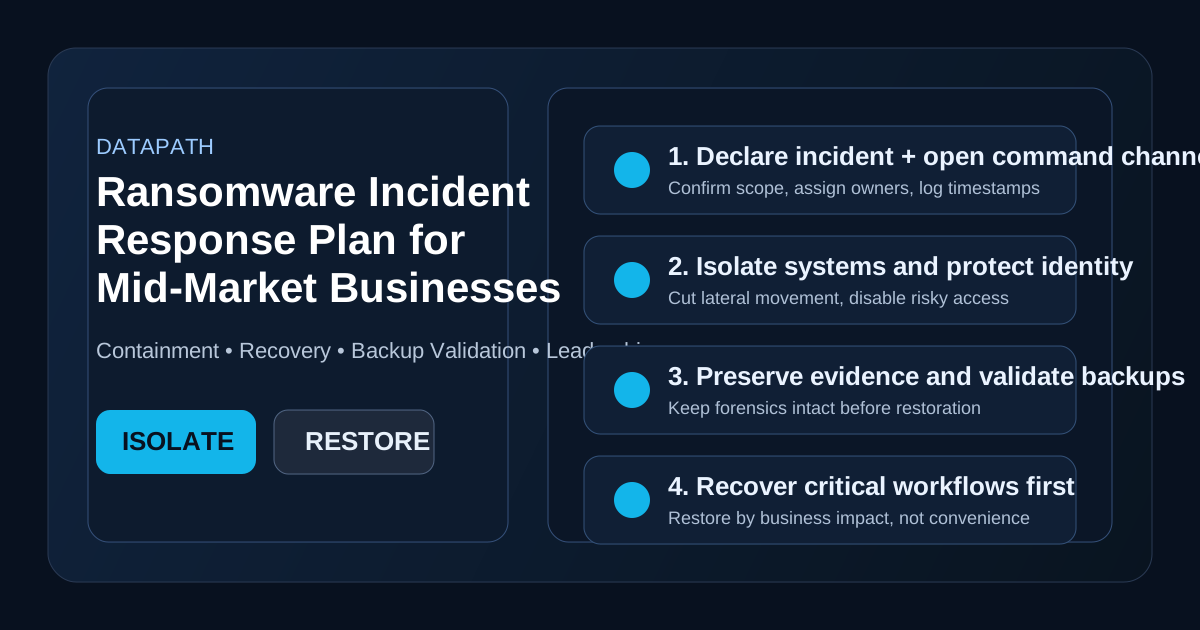
A ransomware incident response plan for a mid-market business should define who declares an incident, how infected systems are isolated, how evidence is preserved, which business functions recover first, how leadership makes legal and communications decisions, and how clean backups are validated before production systems return.123 If those answers are vague when an attack starts, the business usually loses time exactly when time matters most.
We see this issue often in growing organizations. The company has security tools, backups, maybe even cyber insurance, but the actual response process still lives in a few people’s heads. That is risky. Ransomware spreads fast, disrupts operations, and forces technical, operational, legal, and reputational decisions at the same time. Mid-market teams need a plan that is specific enough to run under pressure without pretending they have a massive enterprise SOC behind them.
Here at Datapath, we recommend treating ransomware planning as part of a broader operating model that connects managed IT services, resilience planning, identity controls, backup validation, and executive accountability. The goal is not to create a binder that sits on a shelf. The goal is to give your team a usable playbook for the first hour, the first day, and the first week after detection.
If your organization is already reviewing cybersecurity risk assessment checklists for mid-market companies, how to build a security awareness drill program for remote staff, or business email compromise response planning, ransomware response is the next operational layer.
Why do mid-market businesses need a ransomware-specific response plan?
Mid-market businesses need a ransomware-specific response plan because generic disaster recovery guidance usually does not answer the hard questions that show up during a live attack.14 Traditional recovery plans may explain how to restore systems after hardware failure, but ransomware introduces containment, forensics, notification, legal review, extortion risk, and business-decision pressure all at once.
That matters because attackers often view mid-market companies as attractive targets. They may not have the staffing depth of a large enterprise, but they still rely on complex systems, cloud platforms, vendor access, and sensitive data.1 In practice, that means a single compromised admin account, unpatched edge system, or phishing event can cascade into major downtime if the response path is unclear.
We think a ransomware plan should answer five business-level questions up front:
- Who is in charge when an event is declared?
- What gets isolated first?
- Which systems recover first, and why?
- Who approves outside communications, legal review, and insurance engagement?
- What evidence must be preserved before cleanup starts?
If leadership cannot answer those questions before an incident, the organization is depending on improvisation.
What roles and decisions should the plan define before an incident happens?
A strong plan should define incident leadership, technical responders, executive decision-makers, legal counsel, communications ownership, cyber-insurance contacts, and external specialists before an incident happens.15 We do not recommend leaving those roles informal.
Who should be on the ransomware response team?
Most mid-market businesses need a response structure that includes:
- an incident commander, usually the senior internal IT leader or designated managed-services lead
- infrastructure and identity responders
- executive leadership for business-risk decisions
- legal or compliance review
- communications ownership for internal, customer, or partner messaging
- finance leadership if payments, fraud exposure, or insurance coordination become relevant
- external forensics or incident-response support
This does not need to be a huge team. It does need to be explicit. We have seen good technical teams lose valuable time simply because nobody was sure who had authority to shut off access, approve emergency vendor work, or trigger customer communications.
What decisions should leadership pre-approve?
Before an incident, leadership should document decision guardrails for:
- emergency isolation of systems or network segments
- disabling privileged accounts
- engaging outside forensics and breach counsel
- notifying cyber-insurance carriers
- restoring from backup versus rebuilding systems
- approving temporary business-workaround processes
- escalating to law enforcement when appropriate
The point is not to predict every scenario. It is to remove avoidable friction from the first few hours.
How should the first 60 minutes of ransomware response work?
The first 60 minutes should focus on confirming the event, isolating affected assets, preserving evidence, and establishing command discipline.23 Mid-market teams can lose control quickly if they jump straight into cleanup without understanding scope.
1. Confirm and classify the event
Start by collecting enough evidence to determine whether you are dealing with ransomware, suspicious encryption activity, a false positive, or another security event. That means looking at endpoint alerts, affected file types, identity activity, network behavior, and any ransom notes or extortion messages.2
2. Isolate affected systems fast
CISA recommends isolating impacted systems immediately, and we agree.2 That may include disconnecting workstations, disabling VPN sessions, blocking admin credentials, isolating servers, or cutting off risky network paths. The earlier your team limits lateral movement, the better your recovery options usually are.
3. Preserve evidence before wiping or rebuilding
Capture what you can before systems are altered: logs, endpoint telemetry, memory captures where appropriate, ransom notes, user reports, and a timeline of actions taken.2 Evidence matters for forensics, insurance claims, legal review, root-cause analysis, and knowing whether attackers still have a foothold.
4. Open a documented incident bridge
We recommend a single command channel, whether that is a secure Teams bridge, incident channel, or war-room process. Someone should log decisions, timestamps, and owners in real time. Chaos gets expensive when the organization cannot reconstruct what happened.
What containment steps matter most during ransomware?
The most important containment steps are account protection, network segmentation, endpoint isolation, vendor-access review, and protecting backups from further compromise.26
Protect identity systems first
Many ransomware events spread through privileged credentials, remote access tools, or poorly governed identity pathways. Resetting or disabling compromised administrative accounts, revoking suspicious sessions, tightening conditional access, and reviewing federation or VPN exposure can prevent the incident from widening.
If your organization has not already reviewed Microsoft 365 posture improvements or a third-party access control audit for MSP agreements, that work directly supports ransomware containment.
Separate clean from potentially compromised infrastructure
Containment is not just about infected devices. It is also about protecting what is still usable. We recommend separating clean backup infrastructure, administrative workstations, identity platforms, and critical recovery tooling from any segment that may already be compromised.
Review vendor and remote-access paths
Attackers do not always stop at the original entry point. During containment, review:
- MSP or third-party admin access
- RMM tooling
- firewall and VPN logs
- backup-console access
- privileged service accounts
- stale or shared credentials
For many mid-market businesses, this is where a plan becomes operational instead of theoretical.
How should recovery priorities be decided?
Recovery priorities should be based on business-critical workflows, not whichever systems seem easiest to restore first.24 We recommend defining a recovery order before an incident happens.
A practical mid-market recovery sequence often looks like this:
| Recovery tier | Example systems | Why they matter |
|---|---|---|
| Tier 1 | identity, network core, secure admin tools, backup access | Without these, broader recovery stalls |
| Tier 2 | ERP, EHR, finance, ticketing, line-of-business platforms | These drive revenue, service delivery, or compliance |
| Tier 3 | file shares, collaboration tools, standard productivity apps | Important, but often recover after critical operations |
| Tier 4 | nonessential systems, test environments, lower-value endpoints | Restore after core workflows stabilize |
That order should reflect your real business. A healthcare group, city department, school district, or finance team will not rank systems the same way. We recommend mapping recovery tiers to business impact, compliance obligations, and manual-workaround limits.
What should the plan say about backups and restoration?
The plan should define where clean backups live, who can access them, how recovery points are chosen, how restored systems are validated, and what must happen before production cutover.27
Backups are only useful if they are recoverable
A lot of organizations say they have backups when what they really have is untested backup infrastructure. For ransomware planning, we care about:
- offline or isolated copies
- immutable storage where appropriate
- protected backup-console access
- documented restoration ownership
- restore testing cadence
- validation of key applications, not just raw server boots
This is one reason we often connect ransomware planning with data backup retention policies, managed NGFW and network segmentation, and broader resilience planning through Datapath.
Validate before reconnecting
Do not rush restored systems back into production without malware review, identity checks, and application validation.7 If attackers still have persistence or the restored environment reconnects to compromised credentials, you may reintroduce the problem.
How should legal, insurance, and communications fit into the plan?
Legal review, cyber-insurance notice, and communications planning should be activated early, not treated as an afterthought.58 Ransomware is not only a technical event.
Legal and compliance review
Depending on the industry and incident scope, the organization may need guidance on notification obligations, evidence handling, contractual duties, or regulatory exposure. A regulated business should not improvise those decisions midstream.
Cyber-insurance coordination
If the company carries cyber insurance, the plan should list the carrier, policy contacts, approved vendors if applicable, and notice requirements. Delayed notification can complicate coverage.
Internal and external communications
Your communications path should answer:
- who informs employees about the disruption
- who can speak to customers or partners
- how service-impact updates are approved
- how leadership avoids speculative statements before facts are confirmed
We strongly prefer short, factual updates over premature certainty. Credibility matters during a disruption.
What should happen after systems are back online?
After systems are back online, the plan should require root-cause analysis, control improvements, documentation updates, and leadership review.14 Recovery is not the finish line. It is the start of the learning phase.
A useful post-incident review should cover:
- initial attack path
- time to detect
- time to isolate
- backup and restore performance
- communication gaps
- vendor coordination issues
- controls that failed or were missing
- controls that worked well and should be expanded
We recommend turning those findings into a tracked remediation plan rather than a generic lessons-learned memo. That work often overlaps with security awareness drill programs, cloud account governance, and service-account or privileged-access cleanup.
Why Datapath for ransomware response planning?
We think ransomware planning works best when it is tied to real operating constraints: lean internal IT teams, aging infrastructure, vendor sprawl, Microsoft 365 dependency, backup complexity, and the pressure to keep the business moving. A mid-market company usually does not need a bloated enterprise playbook. It needs a response model that is clear, practiced, and realistic.
At Datapath, we help organizations strengthen the layers that make ransomware response more manageable: identity control, segmentation, backup readiness, managed infrastructure accountability, and practical security operations. If your current plan is mostly a document template and a hope that the right people will answer their phones, it is probably time to tighten it up.
Frequently Asked Questions
What is the first thing a mid-market business should do during ransomware?
The first step is to confirm the incident and isolate affected systems fast. That usually means disconnecting impacted assets, protecting identity systems, and opening a documented incident command process before cleanup begins.2
Should a ransomware response plan be separate from a disaster recovery plan?
It should be connected, but not identical. Disaster recovery explains how systems come back. A ransomware response plan also covers containment, evidence preservation, legal review, communications, and attacker-driven disruption.4
How often should a ransomware response plan be tested?
We recommend at least annual tabletop testing, plus targeted drills whenever major infrastructure, backup architecture, identity controls, or outside-response vendors change. Higher-risk environments should test more often.
What backup capability matters most for ransomware recovery?
The most important backup capability is having clean, accessible, tested recovery points that attackers cannot easily encrypt or delete. Offline, immutable, or otherwise isolated backup paths materially improve recovery options.7
When should a company involve outside incident-response specialists?
A company should involve outside specialists as soon as the event exceeds internal capacity, affects critical systems, raises regulatory or legal concerns, or creates uncertainty about attacker persistence. Pre-vetted external support is much easier to use than scrambling during an outage.5
Sources
- Incident Response Plans: Why Mid-Market Companies Need One
- Ransomware Response Checklist | CISA
- Building An Effective Ransomware Incident Response Plan
- Essential Ransomware Protection Strategies for Middle-Market Businesses
- Building an Incident Response Plan for Ransomware Attacks
- Ransomware Recovery Playbook: A 10-Step Guide
- Ransomware Recovery Guide: Strategies to Save Your Data
- Ransomware Incident Response: A Protection & Recovery Guide
Footnotes
-
Incident Response Plans: Why Mid-Market Companies Need One ↩ ↩2 ↩3 ↩4 ↩5
-
Ransomware Response Checklist | CISA ↩ ↩2 ↩3 ↩4 ↩5 ↩6 ↩7 ↩8 ↩9
-
Building An Effective Ransomware Incident Response Plan ↩ ↩2
-
Essential Ransomware Protection Strategies for Middle-Market Businesses ↩ ↩2 ↩3 ↩4
-
Building an Incident Response Plan for Ransomware Attacks ↩ ↩2 ↩3
-
Ransomware Recovery Guide: Strategies to Save Your Data ↩ ↩2 ↩3
-
Ransomware Incident Response: A Protection & Recovery Guide ↩