
What is threat and incident response?
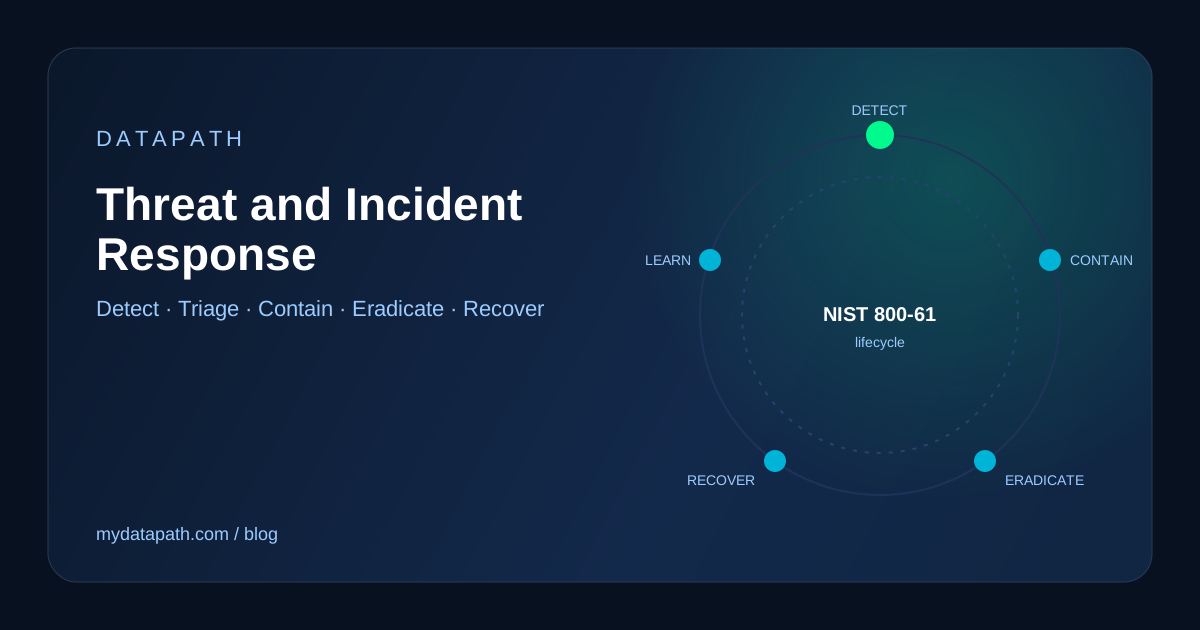
Threat and incident response is the operational lifecycle of detecting suspicious activity, triaging it, containing the damage, eradicating the cause, recovering normal operations, and learning from the event. NIST formalizes this as a continuous loop — preparation, detection and analysis, containment, eradication, recovery, and post-incident activity — rather than a one-time runbook.1 CISA reinforces the same point in its ransomware guidance: organizations should create, maintain, and regularly exercise an incident response and communications plan so the team can coordinate under pressure.2
For a mid-market business, the bar is not “detect everything.” The bar is shorten the window between the first signal and a coordinated, contained response. That window — sometimes called dwell time — is where ransomware spreads, attackers harvest credentials, and a recoverable incident turns into a public one.
Datapath operates threat and incident response for healthcare, K-12, and financial services clients across California and Ohio. The patterns below are what we see consistently separate teams that absorb incidents from teams that get pulled under by them.
Why does the gap between detection and response matter so much?
Because most mid-market incidents are not stopped by a tool — they are stopped by a decision.
Endpoint detection, email security, and network monitoring will all generate alerts when something is wrong. The damage happens in the minutes or hours that follow, depending on:
- Whether someone qualified is actually watching at 2 a.m. on a Saturday
- Whether that person has authority to isolate a host without a manager’s approval
- Whether the vendor or MSP knows your environment well enough to act, not just escalate
- Whether the team has rehearsed who calls legal, who calls the insurer, who calls executives
If any of those break, the dwell time extends — and so does the blast radius. CISA’s #StopRansomware guide explicitly highlights coordinated detection and response, immediate isolation, and documented communications as the controls that compress this window.2
If you want to stress-test those handoffs before a real incident, our cyber incident response tabletop exercise checklist walks through the scope, scenarios, and decision points to put on the table.
What are the phases of a real-world incident response lifecycle?
The NIST SP 800-61r2 lifecycle is the most widely referenced model.1 In a mid-market environment, here is what each phase actually looks like in practice.
1. Preparation
The phase that determines how every other phase runs.
- Documented runbooks for the top scenarios (ransomware, business email compromise, identity compromise, third-party breach, destructive malware)
- Named decision authority for containment actions — who can isolate a host, disable an account, pull a circuit
- Pre-negotiated escalation paths to legal counsel, cyber insurance, and outside forensic responders
- An internal communications plan that does not depend on the systems that may be compromised
- A current asset and identity inventory so responders are not learning the environment during the incident
This is also where an incident response retainer earns its money — the worst time to procure a forensics firm is during a live event.
2. Detection and analysis
The signal arrives. The clock starts.
Strong programs combine:
- 24/7 endpoint detection and response (EDR or MDR) with human triage, not just automated alerting
- Identity threat detection for Microsoft 365 / Entra ID — rogue inbox rules, MFA bypass, conditional-access tampering
- Network and DNS telemetry to spot command-and-control traffic
- Email security signals for phishing-driven compromise
The job in this phase is separate signal from noise quickly and decide: is this a real incident? CISA’s ransomware checklist recommends preserving system images, memory captures, and logs before any containment action that might overwrite them.2
3. Containment
The first phase that meaningfully changes the outcome. Containment is usually layered:
- Short-term: Isolate affected hosts, disable compromised accounts, block attacker infrastructure at the firewall and DNS layer.
- Long-term: Apply patches, rotate credentials, harden conditional-access policies, and remove persistence (autoruns, scheduled tasks, rogue API keys).
Containment requires speed and judgment. Pulling the wrong system offline can break clinical care or stop wires; leaving it online can let the attacker pivot. This is where pre-defined decision authority — and someone empowered to use it — matters more than any tool.
4. Eradication
Once contained, the cause has to be removed, not just suppressed. That means:
- Identifying the initial access vector (phished credential, exposed RDP, unpatched VPN, supply-chain compromise)
- Removing every persistence mechanism — not just the obvious one
- Validating that backups are clean before any restoration
- Closing the door used to get in (MFA, conditional access, patching, network segmentation)
Skipping this phase is how teams end up reinfected within days.
5. Recovery
Restoring systems and watching closely. The temptation is to declare victory once email is back. Mature teams instead:
- Bring systems back in priority order, not all at once
- Monitor restored systems aggressively for re-emergence of attacker activity
- Communicate transparently with users, customers, and regulators where required
- Validate that recovery time and point objectives held — and document where they did not
If your backup posture is part of the recovery plan, our backup and disaster recovery guide covers what “recoverable” actually has to mean.
6. Post-incident activity
The phase most commonly skipped — and the one with the highest long-term ROI.
- Hot-wash the event with everyone involved within a week
- Update runbooks with the gaps the incident exposed
- Rebuild the communications and decision-authority paths that did not work
- Track remediation actions to closure with named owners and dates
- Feed lessons learned into the next tabletop exercise
NIST is explicit: “Lessons learned” is a phase, not a memo.1
What does a mid-market threat and incident response program actually look like?
Stripped down, an effective program for a 100–2,000-person organization usually has six layered components:
- 24/7 monitoring — EDR/MDR + Microsoft 365 ITDR + network/DNS telemetry, watched by humans, not just dashboards.
- Documented runbooks — for the five-to-seven scenarios most likely to hit the business.
- Defined decision authority — who can isolate, who can disable, who can authorize disclosure.
- Pre-arranged outside help — incident response retainer, breach counsel, cyber insurance carrier contacts.
- Backup and recovery validation — restoration tested at least quarterly with documented results.
- Continuous practice — at minimum one tabletop per year, ideally one per critical scenario.
Endpoint and identity controls feed the monitoring layer. If you are still weighing endpoint architecture, our breakdown of EDR vs. antivirus for mid-market businesses covers what to look for.
How does Datapath operate threat and incident response for clients?
The short version: we treat detection, decision, and containment as one continuous workflow, not separate teams handing tickets to each other.
- Our security operations team monitors EDR, identity, network, and email signals 24/7 and is authorized — by pre-negotiated agreement with each client — to isolate hosts, disable accounts, and block infrastructure on first credible indicator.
- Each client has a documented runbook for the scenarios that matter to their environment, refreshed quarterly.
- For events that exceed our scope (forensic-grade investigation, regulator-facing breach response), we coordinate with named outside responders — no procurement delay during the incident.
- Lessons learned feed back into the runbooks and the next tabletop, so the program improves with every event instead of resetting after each one.
The best moment to set this up is before the first real incident — not during it. If your team is still mapping out who calls whom on a Saturday morning, that’s the gap to close first.
Talk to a Datapath security engineer about a threat and incident response review. We will benchmark your current detection coverage, response authority, and recovery posture against the NIST lifecycle and identify the two or three changes that compress dwell time the most.
Frequently asked questions
What’s the difference between threat detection and incident response?
Threat detection is the technical layer — telemetry, alerts, hunting — that surfaces suspicious activity. Incident response is the operational discipline that turns those alerts into contained, eradicated, and documented events. A program needs both; one without the other produces either silent compromises or chaotic responses.
How fast should containment happen?
For high-confidence indicators (confirmed ransomware execution, confirmed identity compromise, active data exfiltration), containment should begin in minutes — not after a multi-hour approval chain. That speed only works if decision authority and runbooks were defined before the event.
Do we need an in-house SOC?
Most mid-market organizations don’t, and shouldn’t try. A managed detection and response (MDR) provider with documented response authority and tight integration into your environment will outperform a thinly staffed in-house SOC for most use cases — and at lower cost. The exception is highly regulated organizations with very specific data-handling requirements that justify the headcount.
How does cyber insurance fit in?
Most carriers require notification within a defined window after an incident is suspected, and they often steer clients to pre-approved breach counsel and forensic firms. Build those contacts into your runbook before the incident; calling your broker mid-event to ask which firm to use is exactly the friction the program should remove.
What’s the single highest-ROI improvement most teams can make?
Practice. Specifically, a realistic tabletop exercise that tests communications and decision-making — not just technical response. The tabletop exercise checklist we publish is a good starting point.
Footnotes
-
National Institute of Standards and Technology, Computer Security Incident Handling Guide (SP 800-61 Revision 2). https://csrc.nist.gov/publications/detail/sp/800-61/rev-2/final ↩ ↩2 ↩3
-
Cybersecurity and Infrastructure Security Agency (CISA), #StopRansomware Guide. https://www.cisa.gov/stopransomware/ransomware-guide ↩ ↩2 ↩3